
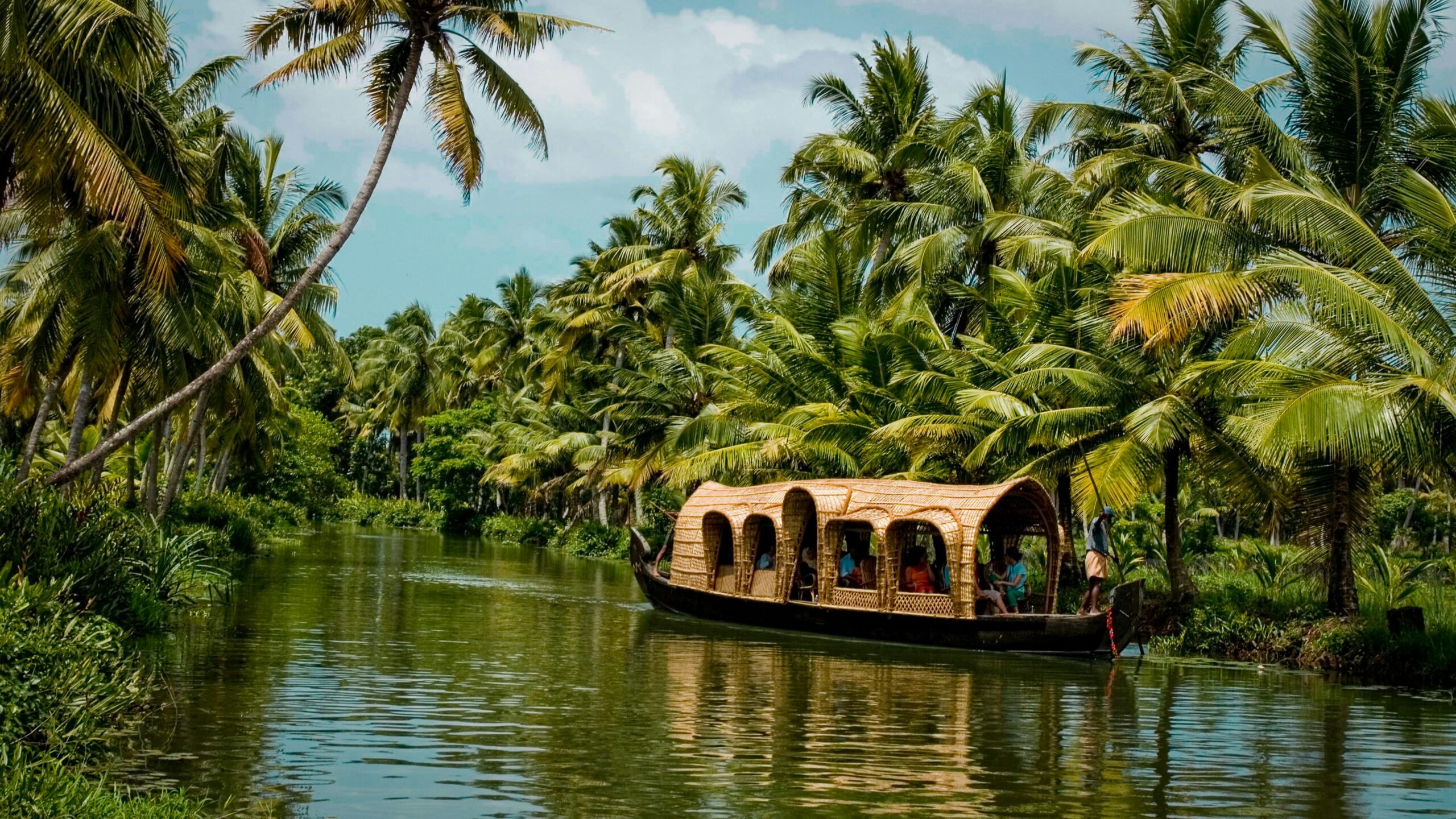
Most people book an overnight houseboat stay in Alleppey knowing two things — they’re getting on a boat, and they’re getting off the next morning. Everything in between is a mystery.
That uncertainty is actually part of the charm. But knowing what to expect makes the experience better, not worse. You stop wondering what’s coming next and start actually being there.
Here’s exactly how a Kerala backwater cruise overnight unfolds — hour by hour, from the moment you board to the morning you check out.
The Starting Point
Most houseboats in Alleppey board from Finishing Point — a jetty near the heart of Alleppey town where boats line up and guests check in. It’s busy, a little chaotic, and it’s where most of the houseboat Alleppey traffic starts its day.
Some operators board from quieter private points away from the main jetty. Less noise, fewer crowds, and the backwaters feel like yours before you’ve even left the shore.
Check-in is at 12 noon.
Boarding and the Welcome
Nobody rushes you onto the boat and disappears.
A good crew takes a few minutes to show you around — the rooms, the deck, what the day is going to look like, the basics you need to know before you’re out on open water. It sets the tone for everything that follows. You get a sense of who’s looking after you and how the next stretch of time is going to feel.
Then the boat moves.
The Cruise Begins
The first stretch opens up in front of you before you’re ready for it.
Wide canals, flat water, coconut trees leaning over the banks on both sides. A fisherman adjusting his net without looking up. Children at the water’s edge who’ve seen a hundred houseboats and still wave at this one. A small temple appearing between the trees and disappearing just as quickly.
You reach for your phone. Then you put it down. Then you pick it up again.
This is also when the birdlife starts to show itself. The Kerala backwaters are home to over 100 species of birds — resident and migratory — and they’re most visible from the water. Kingfishers dart low across the surface in flashes of blue and orange. Grey Herons stand motionless at the canal edge, watching. Purple Herons lift off from the reeds in slow, heavy wingbeats. Cormorants dry their wings on low branches, wings spread wide. Indian Pond Herons crouch in the shallow grass, almost invisible until they move. In the winter months — October through February — the numbers multiply significantly as migratory birds arrive from as far as Siberia, including Painted Storks, Whistling Ducks, and the striking Brahminy Kite circling overhead.
For anyone who didn’t come specifically to birdwatch, it’s still a surprise. The backwaters have more life in them than they appear to from photographs.
After a while, the route shifts into something narrower. The boat slows. The trees close in overhead and the light comes through in patches. The canal is quiet in a way that actually makes you lower your voice. You’re not watching the backwaters anymore — you’re inside them.
This is the part nobody can fully explain before you experience it.
What You’re Passing Through — Kuttanad
As the boat moves through the landscape, the paddy fields that stretch out on either side of the canals are worth a moment of attention.
This region is called Kuttanad — known as the Rice Bowl of Kerala — and it holds a distinction that most people don’t expect. It has the lowest altitude in India and is one of the few places in the world where farming is carried out 1.2 to 3 metres below sea level, on land that was reclaimed from the lake itself over generations. The United Nations Food and Agriculture Organisation recognised the Kuttanad Below Sea-Level Farming System as a Globally Important Agricultural Heritage System in 2013.
What you’re looking at from the houseboat — flat green fields sitting below the waterline, held back by earthen bunds while the canal runs alongside — is one of the most quietly extraordinary things you’ll see anywhere in India. Most people float past it without knowing what they’re looking at.
Lunch on the Water
Around 1 PM the boat pulls over and parks along the route.
Lunch comes out fresh — Kerala rice, fish curry, a handful of sides you didn’t expect, served on a banana leaf the way it’s meant to be. The boat stays still for around 45 to 60 minutes. There’s no rush. Eat slowly. The water isn’t going anywhere.
After lunch, the Kerala backwater cruise continues and the afternoon opens up. No agenda. Nothing you’re supposed to be doing. Just the boat, the water, and however much of it you want to take in.
The Evening — Activities and Anchoring
As the afternoon drifts toward evening, the mood shifts.
This is when most guests want to get off the boat and explore a little. Narrow canal rides, kayaking, shikara rides, speedboat trips, a short village walk along the banks — these are the kinds of things that can be arranged through the crew during your Alleppey houseboat overnight stay. Just ask when you board and they’ll sort out what’s possible. What’s available varies from operator to operator, so it’s worth checking early.
By 5:30 to 6 PM, the boat anchors for the night. Under Kerala’s DTPC regulations, all houseboats must stop sailing at this hour — a rule put in place to protect local fishermen who cast their nets on these same waters after dark. The engine goes off. The water settles. The backwaters that have been moving past you all day become the view you’re sitting inside.
It’s a different kind of quiet.
Dinner and the Night
Dinner is at around 8:30 PM.
The boat is still. The water is dark and flat. There are no cars, no city sounds, no background hum of anything. Just the occasional call of a night bird somewhere in the trees and the soft sound of water against the hull. And then there’s the moon. On a clear night, the reflection sits perfectly still on the surface — a long column of light on black water, broken only when a fish rises or a light breeze moves through. Eating out here, with nothing around you but water and sky, is genuinely one of those moments that doesn’t need anything added to it.
The kitchen wraps up around 9:30 PM. The crew has been working since noon — navigating, cooking, managing the day. By 10 PM the boat settles fully into the night.
Here’s the thing about 10 PM on the backwaters — there’s nothing to miss outside. The water is black, the sky is full of stars that most people haven’t seen in years, and the silence sits on everything. For your own safety and comfort, the crew will gently advise guests to retire to their rooms at this hour. The night air on open water shifts after 10, and the rest genuinely does you good. The backwaters will still be there in the morning — and they look even better then.
Morning — Back on the Water
The backwaters in the morning are different from everything that came before.
Mist sitting low on the water. Birds moving through the trees before the heat comes in — the same herons and kingfishers from yesterday, working the canal in the early stillness. The water completely flat in a way it won’t be again for the rest of the day.
Most guests are up early without meaning to be. And they don’t mind at all.
Breakfast is served at around 8 AM. The boat is back on the water before check-out, and that last stretch of morning cruising — mist lifting, the canal waking up around you — is worth being awake for.
Check-out is at 9 AM.
How Gokul Cruise Approaches This Differently
The luxury houseboat Alleppey overnight experience described above is the general shape of things. How it’s actually executed is where the difference lies.
Gokul Cruise boards from a private point near Finishing Point — away from the main jetty crowd. The experience starts without the chaos.
Our routes are chosen deliberately. Quieter canals, less traffic, stretches that most of the main fleet doesn’t take. The goal is always more time on the water and less time waiting behind other boats.
Anchoring for the night is at a private fixed spot used exclusively by Gokul Cruise boats. No cluster of other houseboats around you. No noise from neighbouring generators. The water at night — and that moonlight on the surface — looks the way it’s supposed to, completely uninterrupted, in every direction.
The crew — captain, helper, cook — is entirely dedicated to your boat for the full stay. No splitting attention across other bookings. No rushing meals because someone else is waiting. Everything runs at your pace, around what you want, for the full duration of your time on board.
Gokul Cruise has been running on these backwaters since 1995. The boats are well maintained, the crew knows these waters the way you know your own neighbourhood, and the experience reflects that — quietly, without making a thing of it.